XenoErotics and Crimes of the Future

A Dual Review

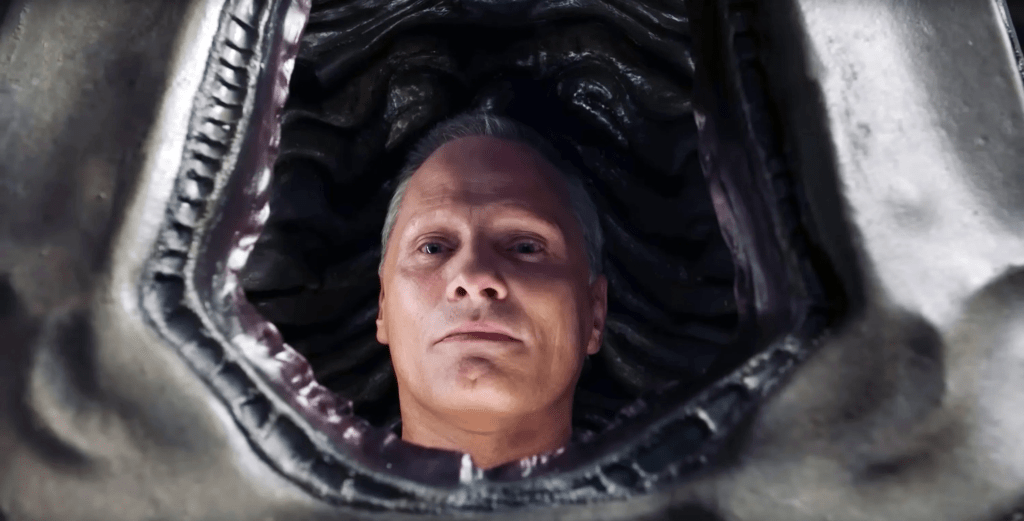
Crimes of the Future is the latest film from master of body horror David Cronenberg, although the title is reused from a movie he made in 1970. Which, fair, it’s a good title and worthy of reuse. Xenoerotics is a short, loose, collection of vignettes and essays whose closest relation to the mainstream is the works of David Cronenberg. I wouldn’t really recommend either to most people, even though I quite liked both.

Crimes takes place at somepoint in a future, where most people have stopped feeling pain, infection has ceased to be a problem, and some people are undergoing rapid evolution and are growing novel organs. The protagonists are a pair of performance artists, one afflicted with the problem of growing new organs and the other who surgically removes them on stage (after endoscopically tattoing them in private) as their performance art. They are played by Viggo Mortensen and Lea Seydoux.

The film feels like a phillip k dick short story, filled with weird scifi flourishes that build out the world in strange and unexpected ways (this is a compliment btw). It is also the kind of film where after the surgical art, characters sit around in the performance space and discuss it’s merits and meanings. Later a skepical character directly asks Viggo, the one who is producing new organs for the performance art, if he is really an artist because he is not in control of the organs growing in him. David Cronenberg knows filmmakers who use subtley and he thinks they’re cowards.

The sets are bare and stripped back, but also evoking the feel and style of Cronenburgs earlier film, Naked Lunch (an adaptation of William Burroughs life and book of the same name). The cast is similiarly stripped down. We meet a pair of goverment beaucrats, tasked with catalouging new organs working for the National Organ Registry. They appear to be the only two employees in the building. It’s unclear if they are the National Registry, or a branch office. There is an unsettling feeling of aloneness.

The film, like a lot of Cronenbergs filmmography is also obbessed with the intersection between eroticism and violence.

Which leads into Xenoerotics by David Roden. Where Crimes of the Future wants to bleed together these two subjects of surgical violence and sexuality, Xenoerotics opens in a universe where any trace of difference between the two has been long ago erased (true to the title, one would actually have to be an alien, or something inhuman, to find any part of it erotic). It’s vulgar book, with the previously mentioned Naked Lunch being the best known work to compare it to. You will probably not be much interested in it. But it does have a few tricks up it sleeve that made it worth reading.

It is told in short vinettes, which are separated into short paragraphs, consisting of sentances that are rarely any longer than they need to be. I have read a few other Vulgar books, like naked lunch, and their biggest failure is that at somepoint they become boring. The vulgar spectacles they engage in are over described again and again. At somepoint the author exhausts the disgust in the reader because the scenes have fallen into the groove of vugarities that the author likes and everything begins to feel the same. Xenoerotics nearly escapes this trap by it’s terseness, it doesn’t linger too long in description of whatever new atrocity is happening before moving on to the next. Allowing the gaps in description to terrify the reader.

It is also told in reverse, with each successive chapter happening before the previous one. There is little to no overlap in characters between chapters, only the slow, strange apocalypse that is happening in reverse. Beginning in a world (the future) that is slowly and counter-causuly brought back to the normal world as the pages flow past.

There is also an interesting gambit happening in the narrative voice. Things flow between first and second person, the way I would write to you if I was writing a letter describing events from yesterday in case you had forgotten them. It brings an intimacy and a strangeness that will probably linger with me longer than any of the descriptions of profoundly awful things carried in the narration.

El Topo

This could be a response to Renegade Cut’s video on Upstream Color. (https://www.youtube.com/watch?v=2YxevRuwiJg). A continuation of those ideas on film. A resistance to explanation, to hard logic and quantification. It’s also a response to whatever else I read and watched and heard over the past little bit of living. Take of it what you will.
RC asks that we stop looking at films as puzzles to be solved, or of chains of arcane symbols to be decoded. Now a look at El Topo, a film that is very literally an assemblage of symbols, although not to the degree of Jodorowskys next film, the Holy Mountain.


Stop watching logically, which is not to say turn off your brain. Turn it on, but to other registers. Watch a movie in the way you’d listen to Beethoven, the way you take in the spectacle of a days end sunset. Free from logic, watch emotionally, intuitively. Ask not what is happening and why is happening, but how does it make you feel and why it does that.
Get to love the texture of the film, the viscosity of moments as they’re strung out in front of and behind you. Not to stop thinking, but to think along new and different paths. [captain planet: heart]. What is the meaning of El Topo or anything else for that matter. Immolate that desire of yours, for like El Topo it will get you nothing. El Topo, the mole: the rules of the duel are always changing, they are in differential.


Is the Colonel God? No of course not, he is the Colonel or is he Immortan Joe (Fury Road)*? They are the same, Emissaries of Patriarchy, male authority, clad in symbols of authority and power to hide underlying weakness of the corrupt and rotten flesh, grown hard with age. (El Topo cannot age, Max cannot age, Stalker stands at the edge of age along with writer who already afraid he is aging away). And yes these are traits shared with the God we ask that the colonel is representative of, but God here is just another emissary of the kind that the Colonel and Immortan Joe are. Even in Jodorowsky, we cannot reduce what we see, we cannot say the exact shape that Gregor Samsa has taken – much less state what Kafka ‘meant’ by it.


So, El Topo kills the patriarch. Jodorowsky has a dim view of people, El Topo (again, the mole) is no Zarathrusta, Jodorowsky has no space in the film for an Ubermensch.


And what of the use of “freaks”, really the differently bodied. They make striking symbols in themselves. We’re all differently bodied, but there is no time for subtlety here. There is no need, a curse on those who would conflate the subtle with the good. Again, let me stress: metaphors are not allegory and both suffer if given true “meanings”. [Roger Ebert – If a symbol does not have readily apparent meaning, it doesn’t. (by golly what a sentence that one is)] Not what does it represent, but how does it feel.

The 4 masters
Blindness gives way to sight, Strength gives into the delicate, a farmer knows as much of death as he does of life, a butterfly net is stronger than a bullet. Here, let me kill myself to teach you this lesson. Twenty years later a son rides off in the clothes of his immolated father with his newborn brother on his back. Perhaps the son is merely another brother. Our mole spirals farther out, perhaps this all repeats in some fashion. (“The man in black fled across the desert, the gunslinger followed.” Only El Topo is the gunslinger in black, both fleeing and following.) Call it eternal return if you like. We
I’m here to prime the pump (a paintbrush is a kind of pump[designing metaphors]) so to speak. Don’t take me with you, leave me be. Go breath out your own words on the issue, tell me what you feel.
*Or Trump for that matter, but there is no need to drag that into this.

You’ve Met Me at a Very Strange Time

I’ve started a blog critically looking at a 40 year old comic from the other side of the world. I haven’t finished reading that comic yet. It’s known as Lone Wolf and Cub. I plan on discussing the large themes at play across the whole story, specific chapters, our idea of Ogami Itto as a character and what we can take away from this masterpiece of a comic.

I’m not sure of what I’m doing, but I hope you’ll follow along with me into Meifumado.

Just What is Meifumado?

From the way Meifumado ( 冥府魔道) gets thrown around by the characters of Lone Wolf and Cub it seems that Meifumado is a well established concept in Japanese culture. It’s not. Koike created the term specifically for Ogami Ittos quest for vengeance. In the Glossary of the Dark Horse volumes it is explained as “The Buddhist hell, the way of demons and damnation”.

As is often the case in the dark horse translation, the word gets an English explainer after it is used. Similar to saying anime animation or manga comics, but the translators have generally seem to have found a rhythm to it and seems natural enough. Here Meifumado is generally expounded as the road to hell or the demon way to hell. With the latter being a fairly literal translation

Meifumado is a compound of two existing words, Meifu ( 冥府 ) and Mado ( 魔道 ). Meifu refers to a sort of underworld, translating to realm of the dead; hell. It has a synonym Jigoku ( 地獄) Which has a more direct connection to a specifically Buddhist Hell. It seems that Meifu is an archaic term borrowed up from the earlier Shinto beliefs and not a direct match for Hell. Much like how places such as Hades, the Abyss and Pandemonium are similar to, but are separate and distinct from the christian Hell.

Mado (魔道) translates to several interrelated concepts. Most clearly as, a way of life characterized as evil or heretical, but also as sorcery, black magic and netherworld outside the six realms where evil spirits roam. Mado also breaks down into two separate words, Ma and do. Ma (魔) meaning witch, demon, or evil spirit. Do (道) is the same as that which appears in bushido (way of the warrior). Giving a literal translation of way of the demon or demon way. It should be noted from this that to take up Mado is also a renunciation of Bushido (Ittos actions aside).

I need to do more research into the cultural specifics of Meifu before deciding, but it seems that Road to Perdition is a very accurate title for the comic that adapted the general idea idea of Lone Wolf and Cub. Perdition being a another particular version of Hell, with the additional (although sadly archaic) definition of utter destruction.

Definitions sourced from wikitionary and https://jisho.org/.

“THOUGH WE BECOME THE DEMONS OF MEIFUMADO! THOUGH WE CLAW FLESH AND DRINK BLOOD, REDUCED TO BONE WE WILL TRANSCEND THE 6 PATHS AND THE FOUR LIVES!” – Ogami Itto to Yagyu Retsudo, fiftieth chapter: The Yagyu Letter.